🏰 The Imperial Legacy: A History of Hereke
Hereke carpets were not born in a village workshop or a bazaar stall. They were born from an imperial decree — a sultan's vision to create carpets worthy of the world's most magnificent palaces. Their story begins not with wool and silk, but with ambition, artistry, and the final golden age of the Ottoman Empire.
📅 A Timeline of Splendour
1843 — The Imperial Command
Sultan Abdülmecid I ordered the establishment of the Hereke Fabrika-i Hümâyûnu (Hereke Imperial Factory) in the coastal town of Hereke, 60 km east of Istanbul on the shores of the Marmara Sea. The primary mission: to produce textiles, upholstery, and drapery exclusively for the great Ottoman palaces — Dolmabahçe, Beylerbeyi, and Yıldız. Until this point, palace floors had been covered with classical Anatolian carpets from Uşak and Gördes — beautiful, but incompatible in scale and style with the new Baroque and Rococo interiors of Dolmabahçe. Importing European carpets was both costly and damaging to Ottoman prestige. Hereke was the answer.
1845 — Production Begins
The factory officially began production, initially focusing on silk fabrics, velvet, and woven textiles. Jacquard looms and expert designers were brought in from France, making Hereke the most technically advanced weaving facility in the Ottoman Empire.
1855 — First International Recognition
Hereke fabrics earned awards at the Paris International Exhibition, marking the factory's debut on the world stage. The Ottoman Empire had created a luxury brand recognized in Europe.
1891 — The Birth of the Hereke Carpet
Under Sultan Abdülhamid II, one hundred new looms were installed and carpet weaving officially began. Master craftsmen were summoned from Sivas, Ladik, and Manisa — the finest weaving regions of Anatolia. At first, palace designers provided the patterns; gradually, the weavers developed their own distinctive style, blending Ottoman court aesthetics with classical Anatolian traditions. The iconic Hereke style — intricate medallions, floral arabesques, and ultra-fine knotting — was born.
1890s–1910s — Diplomatic Masterpieces
Hereke carpets became the ultimate diplomatic gift of the Ottoman sultans. Visiting emperors, kings, and heads of state received Hereke pieces as tokens of imperial friendship. A landmark example: in 1897, a 468-square-metre, 3-tonne carpet was woven for the Yıldız Şale Pavilion to honour the visit of German Emperor Kaiser Wilhelm II — still one of the largest carpets ever woven. It was not until 1890 that the public was permitted to purchase Hereke carpets at all.
20th Century — Republican Era & Revival
Following the fall of the Ottoman Empire, the factory continued operations under Sümerbank, a state enterprise. Though production slowed in the early Republican period, master weavers kept the tradition alive. The factory eventually came under the administration of the Presidency of National Palaces, where it continues to operate today — hand-weaving on the same wooden looms, using the same techniques, unchanged since 1843.
Today — A Living Heritage
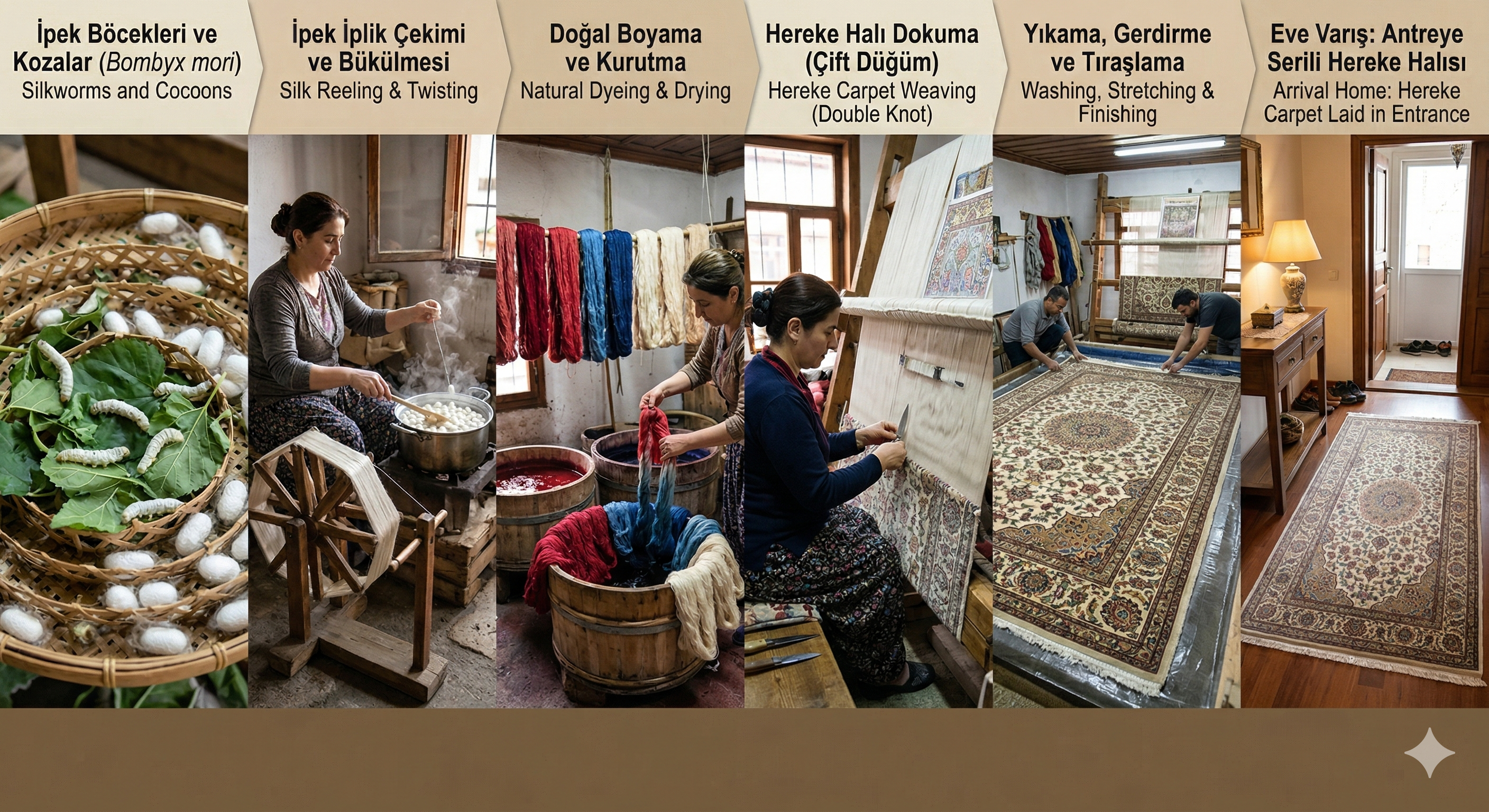
After 182 years of uninterrupted production, Hereke carpets still grace the floors of Dolmabahçe Palace, the Beylerbeyi Palace Blue Hall, the Hague International Court of Justice, and even the White House. Each carpet remains entirely hand-woven, without a single automated process. For 1 centimetre of fabric, the shuttle passes 60 times; a 60 cm section requires 3,600 precise hand movements.
🏅 International Exhibition Awards
Within half a century of its founding, Hereke had conquered the great exhibition halls of Europe:
1855Paris — Award for Silk Ribbons
1862London — Medal for Silk Weavings
1892Vienna — Grand Prize
1894Lyon — Grand Prize
1910Brussels — Grand Prize
1911Turin — Grand Prize
1843
Year the Imperial Factory was founded
468 m²
Largest carpet ever woven at Hereke (Yıldız Şale, 1897)
2.25M
Maximum knots per m² in silk Hereke carpets
182
Years of uninterrupted production (as of 2025)
"The greatest palaces in the world should also display the finest carpets in the world."
— Sultan Abdülmecid I, 1843
🌟 Why Hereke Stands Apart
Before Hereke, the finest Anatolian carpets came from village workshops — woven by tradition, shaped by region. Hereke was different from its first day: it was a royal atelier, designed not to supply a market but to express imperial power on the floor. The designs were drawn by palace artists, the materials selected by the sultan's court, and the weavers were the most skilled craftsmen from across the empire.
This combination of court aesthetics, technical mastery, and the finest raw materials — pure silk, natural dyes, sometimes gold and silver thread — produced a carpet unlike any other in the world. The Ghiordes double knot, applied at densities far exceeding any contemporary production, gave Hereke its characteristic sharpness of pattern and extraordinary durability.
Today, a genuine Hereke carpet can be identified by its woven signature, its extraordinary knot density (up to 2,250,000 knots per m² in silk), and the unique luminosity that changes with the viewing angle — an effect no machine can replicate.