🧵 Materials, Tools & Techniques
From raw wool on the hillside to a finished masterpiece on the loom — every step matters.
🐑 The Raw Materials
🐑 Wool — Yün
Most Common Natural FibreWool is the backbone of Anatolian carpet weaving. The finest quality comes from sheep raised at high altitude, where cold winters produce a dense, lustrous fleece with long, strong fibres. Wool holds natural dyes beautifully — colours often deepen and improve with age, a quality absent in synthetic fibres.
Kurk (Kırkım yünü): The highest grade — first spring shearing from the neck and belly. Silky, long-stapled, and luminous. Used in premium village carpets.
Ordinary wool: Later shearings — shorter fibre, more common in commercial production.
Best regions: Taurus mountain Yörük wool (Döşemealtı, Ayvacık), Kars highland wool.
🥚 Silk — İpek
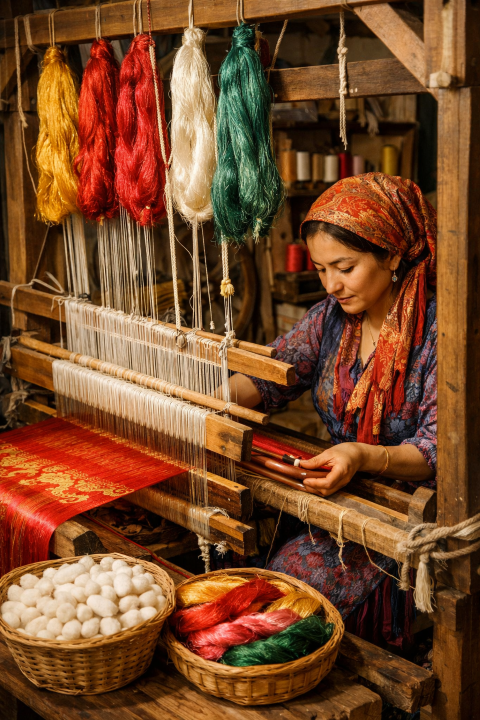
Luxury HerekeSilk is the most prestigious carpet fibre — fine enough to achieve over 2 million knots per square metre, yet stronger than steel for its weight. Silk carpets shimmer and change colour with viewing angle; no other material replicates this effect.
Source: Silkworm (Bombyx mori) cocoons, fed exclusively on mulberry leaves. A single cocoon yields up to 1,500 metres of continuous thread.
Silk on Silk: Both warp and pile are silk — maximum fineness, maximum cost.
Silk on Cotton: Cotton warp with silk pile — slightly less fine but more stable.
Primary centre: Hereke (Kocaeli). Also Kayseri for commercial silk blends.

🌿 Cotton — Pamuk
Warp & Weft FoundationCotton is rarely used for pile but is widely used as the warp and weft foundation in town carpets (Kayseri, Isparta, Sivas). It provides a more stable, less elastic foundation than wool, enabling finer knotting. Cotton warps do not stretch with humidity like wool.
Cotton pile appears in a few specific traditions — notably the white highlight knots in some Hereke and city carpets, where its bright, stable white cannot be replicated by wool.

🐐 Goat Hair & Camel Hair
Tribal NomadicUsed primarily in tribal and nomadic weaving — flat-weaves, storage bags (heybe), tent dividers. Goat hair (kıl) is exceptionally strong and weather-resistant; it does not absorb moisture like wool.
Camel hair (deve tüyü): Prized for its natural golden-brown tones. Used in some Kayseri and eastern Anatolian carpets. Cannot be dyed — its natural colour is its beauty.
Found in: Kars kilims, Yörük weavings, Ayvacık tribal pieces.
🎨 Natural Dyes — Doğal Boyalar
For centuries, Anatolian weavers dyed their yarns exclusively with plants, insects, and minerals. These natural dyes do not fade uniformly — they develop a patina over time, colours deepening and harmonising in a way synthetic dyes never achieve. The DOBAG project (1981, Ayvacık) was the first modern initiative to revive 100% natural dye carpet weaving in Turkey.
| Plant / Source | Colour | Turkish Name | Notes |
|---|---|---|---|
| 🌹 Madder root (Rubia tinctorum) | Red, orange, pink tones | Kökboya | The most important dye plant. Yağcıbedir reds are legendary for brightening with age. |
| 🔵 Indigo (Indigofera tinctoria) | Blue, navy, turquoise | Çivit | Used via vat dyeing. Combined with madder to produce purple. |
| 🌿 Weld (Reseda luteola) | Yellow, gold | Muhabbet çiçeği | Most common yellow dye plant. Also used in overdyeing for green (with indigo). |
| 🌰 Oak galls & iron | Black, dark brown | Mazı / Demir suyu | Iron mordant with tannin. Excess iron can weaken wool fibres over time — antique black areas often show corrosion. |
| 🧅 Onion skins | Golden yellow, orange | Soğan kabuğu | Widely available, easy to use. Produces warm golden tones. |
| 🌿 Pomegranate rind | Yellow-green, beige | Nar kabuğu | Also acts as a mordant. Common in Milas and Aegean weaving. |
| 🌲 Walnut shells / husks | Brown, khaki | Ceviz kabuğu | No mordant needed. Very lightfast and stable. |
| 🧪 Alum (mordant) | — | Şap | Most common mordant. Opens wool fibre to accept dye. Essential for madder and most plant dyes. |
— Fatih Mehmet Canıtez
🏗️ Loom Types — Tezgah Çeşitleri
The loom (tezgah) is the fundamental structure that holds the warp threads under tension while the weaver ties knots. Different loom types suit different contexts — nomadic life, village workshops, or imperial factories.
📐 Horizontal Ground Loom
Yatay Tezgah
The oldest and simplest type. Staked to the ground, low to the floor. Ideal for nomadic life — easily dismantled and transported. Produces relatively small rugs with slightly uneven tension. Found in tribal and Yörük weaving.
📐 Fixed Village Loom
Sabit Köy Tezgahı
Vertical loom with a fixed upper beam and movable lower beam. Tension maintained with wooden wedges. Weavers sit on a plank raised as work progresses. Standard in Anatolian village production.
📐 Roller Beam Loom
Döner Leventli Tezgah
Traditional Turkish village loom. Two movable beams with ratchet locks — completed work rolls onto the lower beam. Allows very long carpets. Used in Yağcıbedir, Döşemealtı, and many Anatolian centres.
📐 Tabriz / Bünyan Loom
Tabriz Tezgahı
Continuous warps pass around behind the loom. Carpet is pulled down and rolled as work progresses; weavers sit on a fixed seat. Used in professional workshops — Kayseri, Bünyan, Hereke. Enables very precise, uniform weaving.
🔧 Weaving Tools — Dokuma Araçları
Each tool in the weaver's hands has been refined over centuries. Together they form a complete system — from preparing the warp to finishing the pile.
Loom
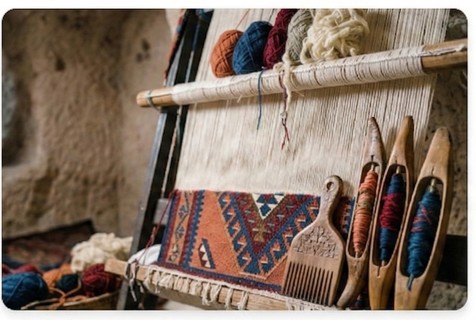
TezgahThe main frame that holds warp threads under tension. The foundation of all carpet and kilim production. Can be horizontal (nomadic) or vertical (village/workshop). Size determines the maximum carpet dimensions.
Weaving Comb / Beater
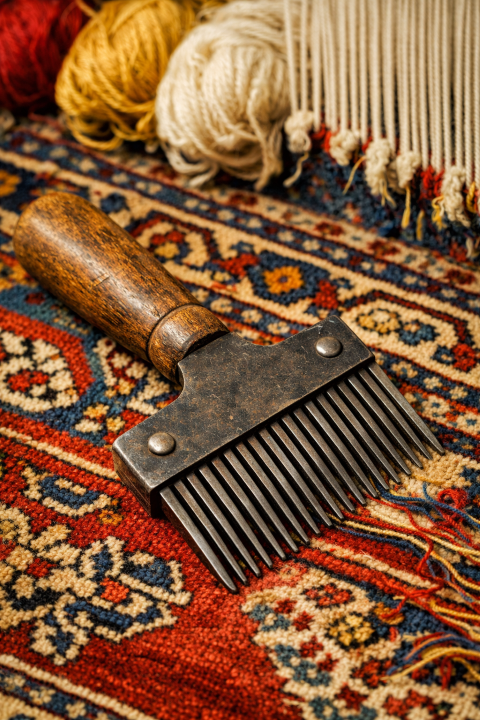
KirkitA heavy comb-like tool — typically metal-toothed with a wooden or metal handle. After each row of knots is tied and the weft thread passed through, the kirkit is struck downward to pack the knots tightly together. The density of the blow determines the carpet's firmness and knot count. One of the most characteristic sounds of a carpet workshop.
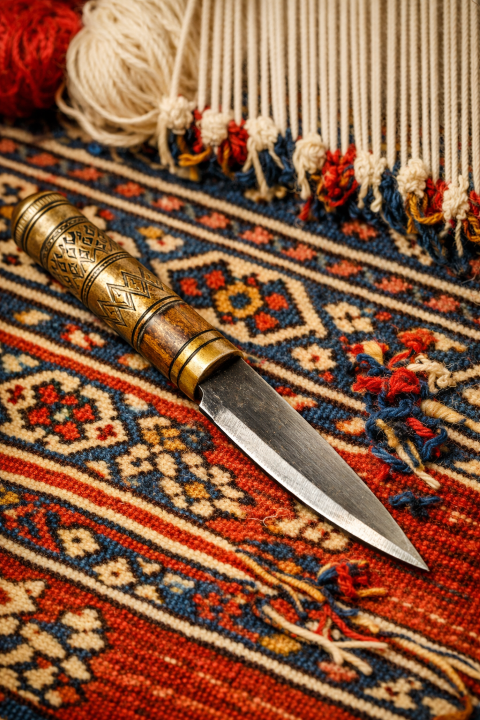
Weaving Knife
Dokuma BıçağıA small hooked knife used to cut the yarn after each knot is tied around the warp threads. The hook allows quick cutting at a consistent length. Skilled weavers can tie and cut up to 10,000 knots per day. The sharpness of the knife directly affects pile uniformity.
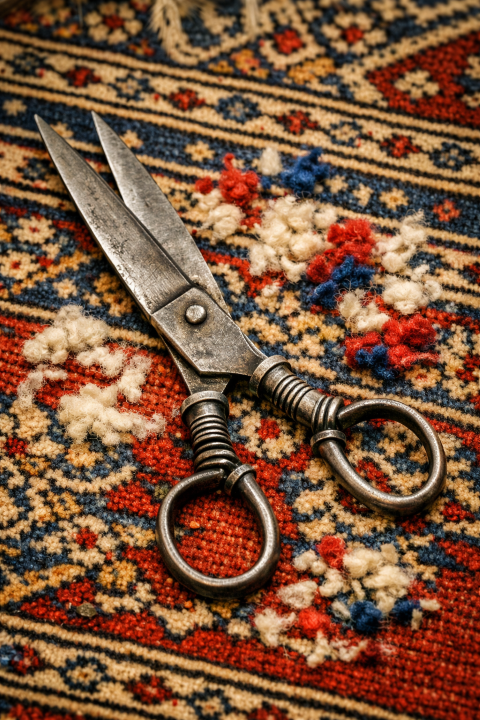
Pile Scissors
Hav MakasıWide, adjustable scissors used to shear the pile to an even height after each completed row — and for the final finishing of the whole carpet. The pile height determines the carpet's texture: low pile gives crisp pattern definition; higher pile gives softness and warmth.
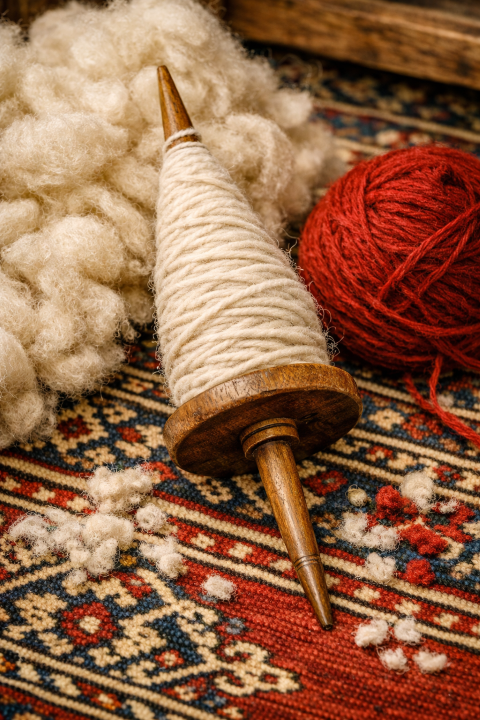
Drop Spindle
İğ / KirmenA weighted stick used to spin raw wool fibre into yarn by hand. In traditional production, women spun all yarn by hand before weaving. The twist of the yarn (S-twist or Z-twist) affects the carpet's texture and light reflection. Hand-spun yarn has natural irregularities that give antique carpets their characteristic warmth.
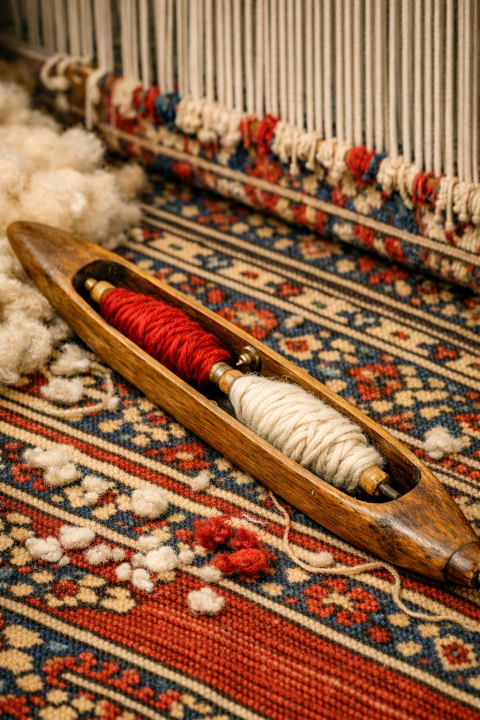
Shed Stick / Heddle
Varagele / ÇerçeveA flat wooden stick or rod inserted between alternate warp threads to create the "shed" — the opening through which the weft thread passes. In kilim and flat-weave, the varagele is raised and lowered to alternate which warps are lifted, creating the interlocking weft patterns.
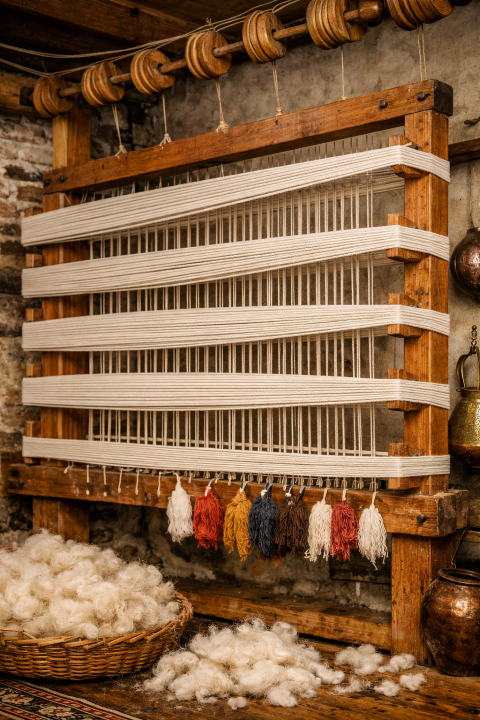
Warping Frame
Çözgü Levent / TaharUsed to prepare the warp — measuring and organising the warp threads to the correct length and density before they are stretched onto the loom. Proper warping is critical: uneven tension in the warp produces a distorted carpet that will not lie flat.
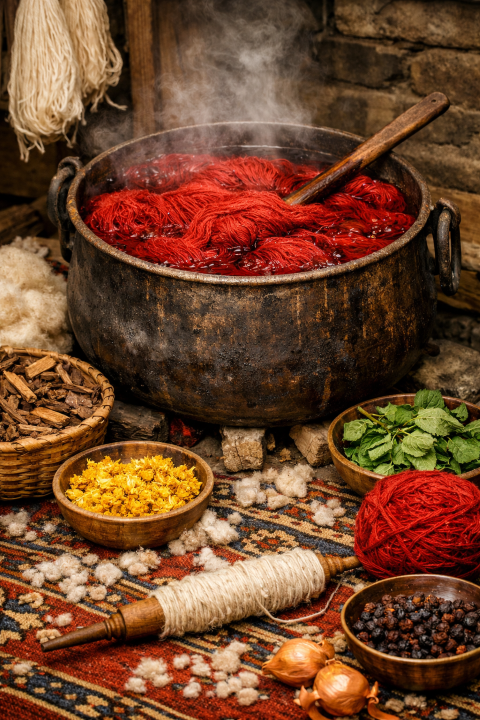
Dye Vat
Boya KazanıA large copper or iron cauldron used to dye yarn. Wool is first mordanted (usually in alum solution), then submerged in the dye bath. Temperature, duration, and mordant type all affect the final colour. Natural dyeing is an art requiring deep knowledge of plant chemistry.
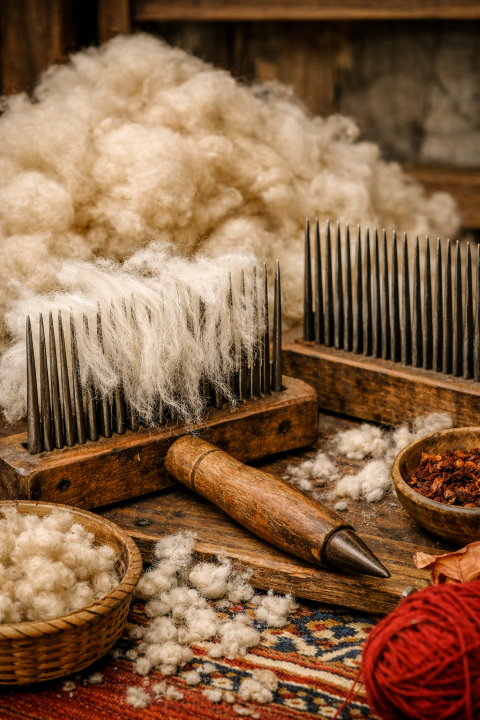
Wool Cards / Comb
Yün Tarağı / TaramaFlat paddles or combs with wire teeth used to align and clean raw wool fibres before spinning. Carding removes vegetable matter, loosens fibres, and aligns them for even spinning. Traditionally done by women by hand — a fundamental step that determines yarn quality.
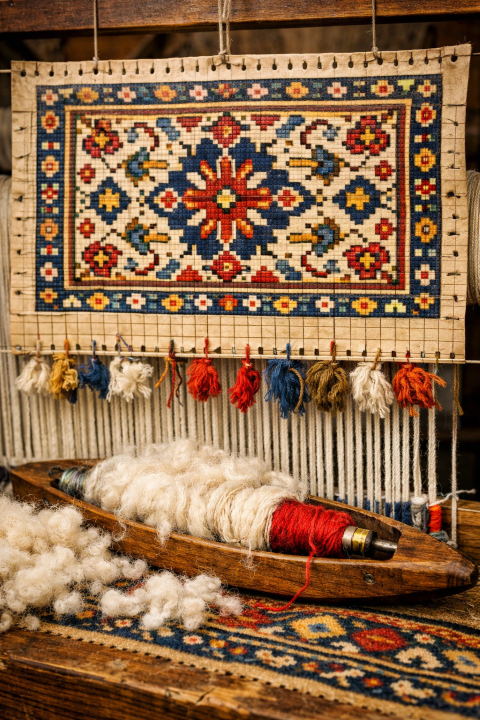
Design Cartoon
Desen Kartonu / Nakış KağıdıA graph-paper design drawn to scale, with each square representing one knot. The weaver follows this colour-coded chart row by row. In village and tribal weaving, patterns are memorised and passed down orally; the cartoon is used in workshop and palace production for complex designs.
🪢 Knot Types — Düğüm Çeşitleri
The strength of a rug lies in its knots. Two primary knot types define Anatolian and Persian traditions — each producing different qualities of durability and pattern precision.
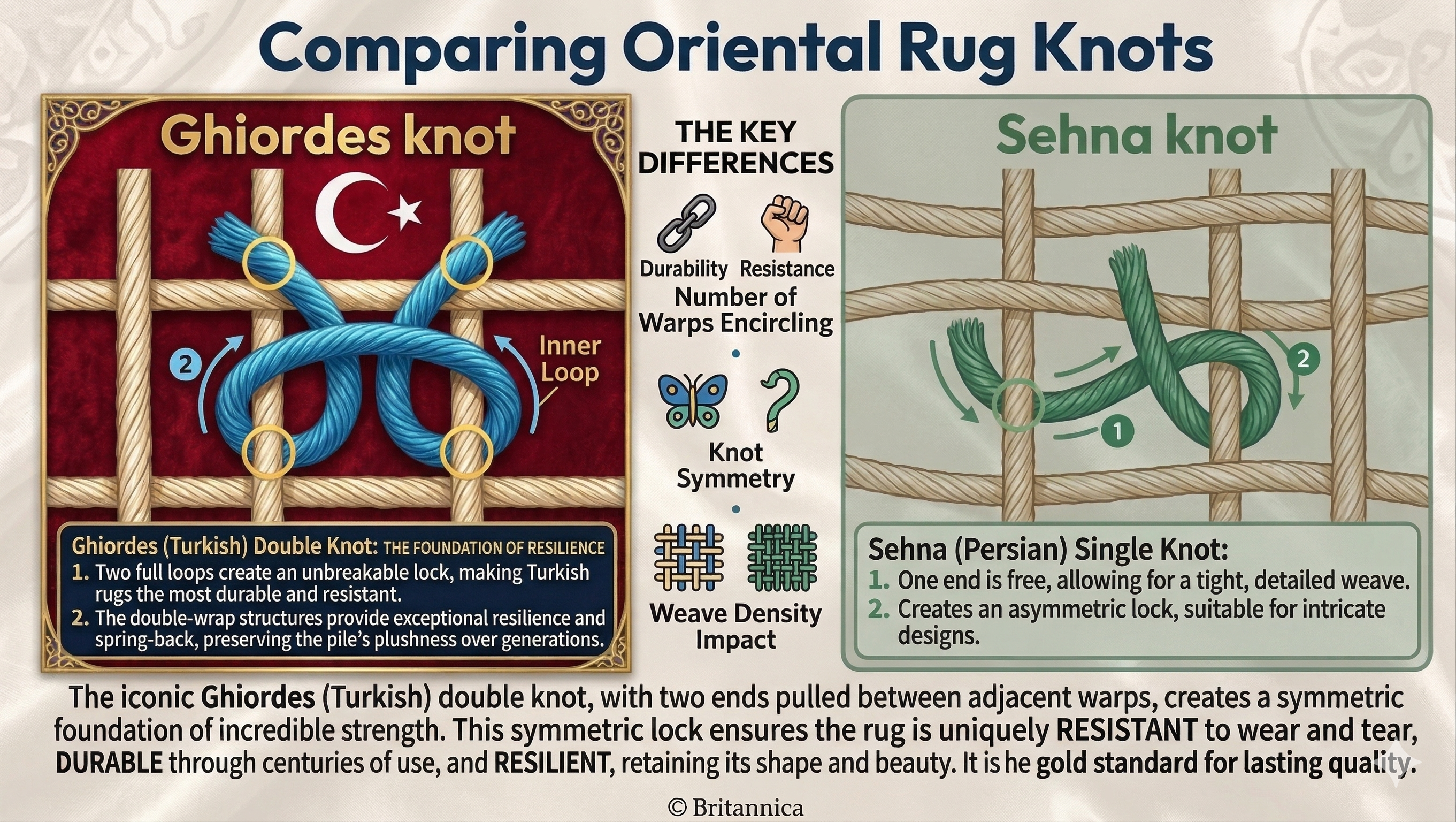
🔴 Turkish Knot (Symmetrical)
Gördes Düğümü / Türk Düğümü
Yarn is looped around two adjacent warp threads, with both ends emerging between them. Produces a symmetrical, firm knot that stands upright. Stronger, more durable, and gives sharper geometric patterns. Standard in all Anatolian weaving from Gördes to Hereke.
Used in: Hereke, Gördes, Uşak, Bergama, Kayseri, and all major Turkish centres.
🔵 Persian Knot (Asymmetrical)
Sine Düğümü / İran Düğümü
Yarn loops around one warp thread, with one end tucked under the adjacent warp. Asymmetrical — can be open left or right. Allows higher knot density and very fine curved designs, but slightly less firm than the Turkish knot. Standard in Persian and some Central Asian weaving.
Used in: Some Hereke silk carpets at ultra-high density, Iranian-influenced pieces.
📊 Knot Density — What the Numbers Mean
| Quality Level | Knots per dm² | Knots per m² | Typical Use |
|---|---|---|---|
| Village / Tribal | 900–1,600 | 90,000–160,000 | Yörük carpets, Döşemealtı, Çanakkale |
| Good Commercial | 1,600–2,500 | 160,000–250,000 | Isparta, Kayseri commercial |
| Fine Workshop | 2,500–4,900 | 250,000–490,000 | Sivas, Kayseri fine, Ladik |
| Hereke Wool | 3,600 | 360,000 | Hereke wool — official standard (60×60) |
| Hereke Silk | 10,000+ | 1,000,000+ | Hereke silk — standard (100×100) |
| Hereke Ultra-Fine | 22,500 | 2,250,000 | Finest Hereke silk — museum quality |
⚙️ The Production Process — Üretim Aşamaları
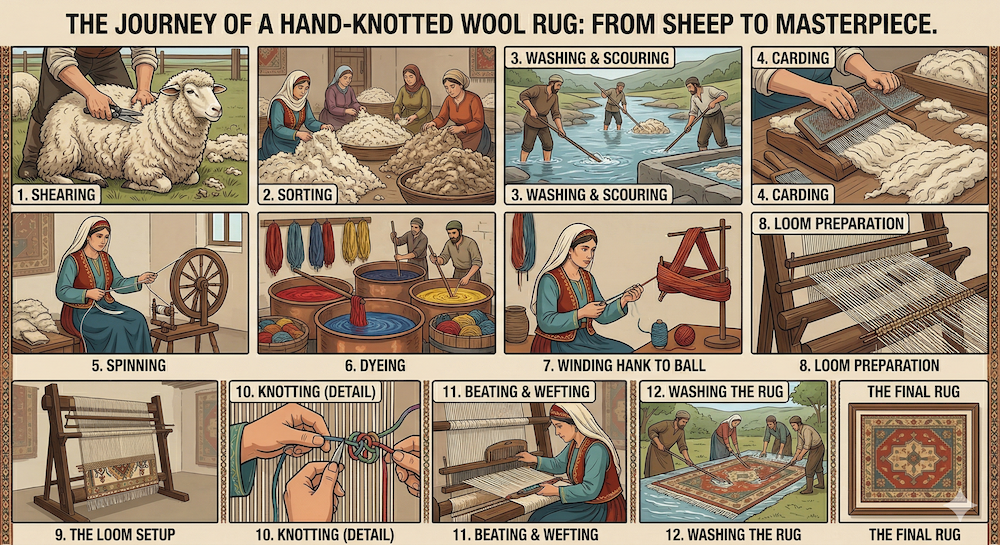
From raw wool to finished carpet — a traditional Anatolian hand-knotted carpet passes through eight distinct stages, each requiring specialised knowledge.
- Shearing (Kırkım): Wool is sheared from the sheep — ideally in spring for the finest kurk quality. The fleece is washed, sorted by fibre length and quality.
- Carding (Tarama): Cleaned wool is combed with wire cards to align fibres, remove debris, and prepare for spinning.
- Spinning (Eğirme): Fibres are twisted into yarn using a drop spindle (iğ) or spinning wheel. The twist direction (S or Z) and tightness affect the yarn's character and the carpet's sheen.
- Mordanting (Mordan): Spun yarn is boiled in a mordant solution (usually alum/şap) to prepare it to accept dye. Different mordants shift the same dye to different colours.
- Dyeing (Boyama): Mordanted yarn is submerged in the dye bath and simmered. Temperature, duration, and dye concentration are controlled by the dyer's experience. Yarn is then rinsed and hung to dry in the sun.
- Warping (Çözgü): Warp threads are measured, tensioned, and mounted on the loom. Correct warping is critical — uneven tension produces a distorted carpet.
- Knotting (Düğümleme): The weaver ties each knot individually around the warp threads, row by row, following the design. After each row: a weft thread is passed through, then the kirkit is used to beat the row firmly downward. Pile is trimmed with scissors to maintain even height.
- Finishing (Bitirme): The completed carpet is cut from the loom. Ends are secured, the pile is sheared to final height and evenness, the carpet is washed in running water, and dried flat in the sun. The wash softens the wool and brings out the natural lustre of the dyes.