🏺 The Pazyryk Carpet
The World’s Oldest Surviving Knotted Rug — c. 500 BCE
Discovery
In 1949, Soviet archaeologist Sergei Rudenko excavated a burial mound (kurgan) in the Pazyryk Valley of the Altai Mountains, Siberia. Inside, preserved for 2,500 years by permafrost, lay a hand-knotted wool carpet measuring 183 × 200 cm.
It is the oldest surviving pile carpet in the world. Today it is housed in the State Hermitage Museum, St. Petersburg.
Technical Specifications
| Feature | Detail |
|---|---|
| Dimensions | 183 × 200 cm |
| Date | c. 500–400 BCE |
| Knot type | Turkish (Ghiordes) double knot |
| Knot density | ~36 knots per cm² |
| Total knots | approx. 1,250,000 |
| Material | Wool pile on wool foundation |
| Origin | Disputed — Achaemenid Persia or Altai steppe |
| Location today | State Hermitage Museum, St. Petersburg |
Motif Analysis
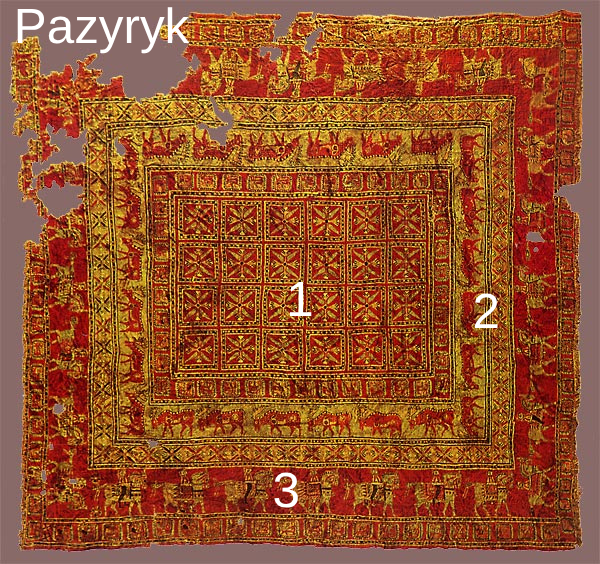
The carpet is structured in three main visual zones, numbered in the diagram above.
Zone 1 — Central Field
The central field contains 24 identical squares (4×6 grid), each bearing a stylised rosette cross motif surrounded by geometric border lines.
- The strict grid layout reflects a highly mathematical weaving tradition — not improvised pattern-making.
- The repeating cross-rosette is one of the earliest documented examples of what would become the gül (flower/medallion) motif in later Turkic carpet traditions.
- The red and yellow contrast dominates — these dyes required madder root (red) and weld or pomegranate rind (yellow), indicating sophisticated natural dyeing knowledge.
Zone 2 — Inner Animal Border
Surrounding the central field runs a border of deer and fallow deer (cervids) in profile, rendered with striking naturalism.
- The deer face alternating directions, creating visual rhythm around the field.
- The posture — legs folded, heads turned — parallels Scythian animal-style metalwork found across the Eurasian steppe from Hungary to Mongolia.
- In nomadic culture, the deer symbolised swiftness, spiritual passage, and the hunt.
- This border is the strongest argument for a local Altai or Scythian origin of the carpet.
Zone 3 — Outer Horsemen Border
The outermost decorated border shows a procession of horsemen — some mounted, some leading horses on foot.
- There are 28 horses and their riders, with visible detail: saddle blankets, bridles, rider clothing.
- Some scholars interpret this as a funeral procession, fitting the kurgan burial context.
- Others read it as a royal cavalcade, symbolising the power and status of the buried chieftain.
- The horses are rendered with anatomical accuracy rare for this period in textile art.
The Origin Debate
🔴 Theory 1 — Achaemenid Persia Rosette and geometric motifs match Persepolis stone carvings closely. Most Western scholars favour a Persian court origin, possibly gifted to a Scythian chieftain.
🟡 Theory 2 — Local Scythian / Altai The deer and horsemen are quintessentially Scythian. The carpet was found in a Scythian tomb — local weavers may have mastered pile-knotting independently.
🔵 Theory 3 — Eastern Anatolia or Caucasus The Caucasus as cultural meeting point explains both the Persian geometry of Zone 1 and the Scythian animals of Zones 2–3 — a product of early Silk Road cultural exchange.
Why It Matters
The Pazyryk carpet proved:
- Pile knotting is at least 2,500 years old — possibly much older.
- The technique was already fully mature by 500 BCE.
- The artistic vocabulary — bordered fields, repeating grids, animal processions — was already established.
- Carpet weaving was connected to royal power, ritual, and cosmology from its earliest origins.
Every carpet woven today carries a thread — however distant — back to this frozen valley in Siberia.
See the Original
🏛️ State Hermitage Museum — Saint Petersburg, Russia — Room 26, Pazyryk Collection
Analysis by Fatih Mehmet Canıtez — 50 years studying the living traditions that connect us to this ancient craft.
← Back to Home 🏛️ Renaissance Masterpieces → 🧶 Weaving Techniques →